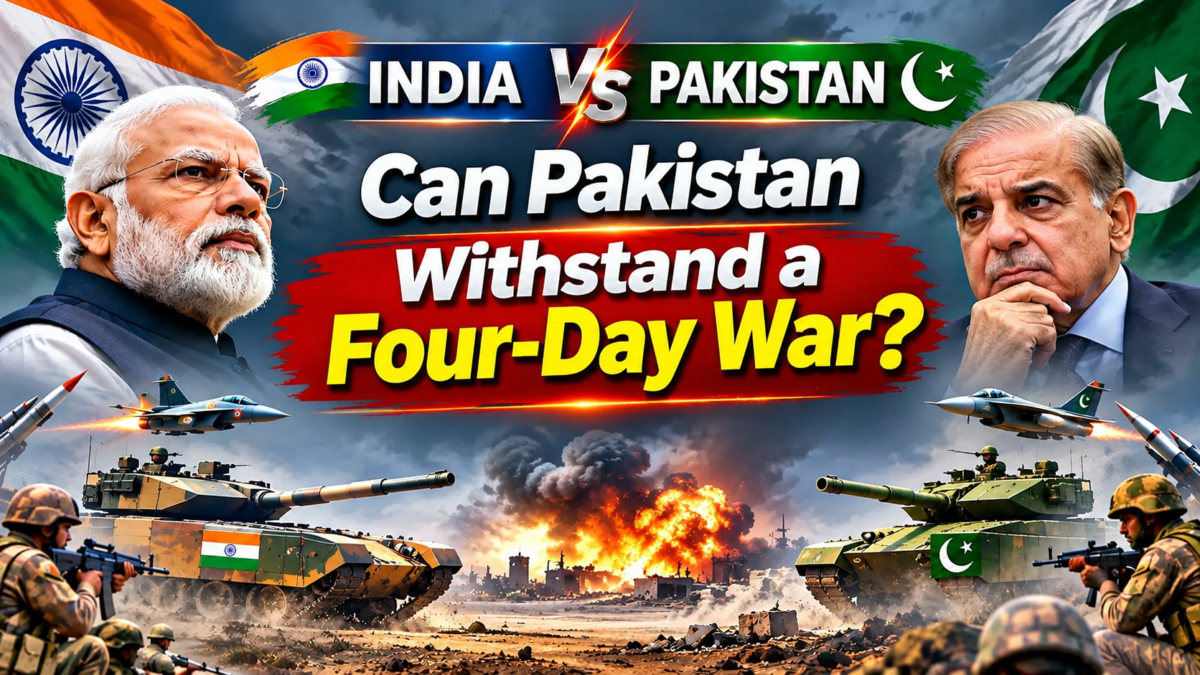
India vs Pakistan Four-Day War: The tension between India and Pakistan is a long-standing issue rooted in historical, political, and territorial conflicts—most notably over Kashmir. While diplomatic engagements occasionally ease tensions, the question remains. if a full-scale war breaks out between the two nuclear-armed neighbors, how long can Pakistan sustain such a conflict? A growing body of evidence suggests that Pakistan lacks the economic stability, military resources, and logistical infrastructure to withstand a prolonged war with India.
1. Economic Constraints Crippling Pakistan’s Military Readiness
One of the foremost issues that Pakistan faces is its declining economy. Inflation, foreign debt, dwindling foreign exchange reserves, and repeated bailouts from the IMF have strained its ability to fund and maintain a modern military force. Former Pakistan Army Chief General Qamar Javed Bajwa himself acknowledged in a private meeting with journalists that Pakistan does not have enough ammunition or financial capacity to engage in a long war with India. Reports cited him saying that the country is struggling with basic logistics such as fuel for tanks and artillery movement.
These statements are not merely political. India vs Pakistan Four-Day War The World Bank and IMF data indicate that Pakistan’s economy is functioning under severe stress, with its defense budget experiencing limitations despite the military’s traditionally dominant role in national affairs.
2. Limited Ammunition and Military Inventory
According to defense analysts and leaked military assessments, Pakistan reportedly has sufficient ammunition to sustain a high-intensity conflict for only about four days. India vs Pakistan Four-Day War In comparison, India’s defense logistics and stockpiles are better equipped to maintain a 45-day war. This significant gap underscores the logistical and supply chain shortcomings in Pakistan’s war preparedness.
The reasons behind this disparity are multifaceted. India has invested heavily in domestic defense production through the “Make in India” initiative and maintains strategic partnerships with multiple global suppliers like France, Russia, and the United States. Pakistan, however, remains heavily dependent on limited defense partnerships, mainly with China, and lacks the industrial base to mass-produce advanced weapons or restock quickly during conflict.
3. India’s Superior Air, Naval, and Ground Power
India holds a qualitative and quantitative edge over Pakistan in all three branches of its military:
- Air Force: India has around 814 combat aircraft including modern platforms like the Rafale, Su-30MKI, and indigenous Tejas jets. Pakistan’s Air Force has around 425 combat aircraft, including older models like the F-16 (acquired decades ago) and China-made JF-17 fighters.
- Navy: India’s naval strength far surpasses Pakistan’s with 1 aircraft carrier, 16 submarines, 13 frigates, and 100+ patrol vessels. Pakistan’s navy, in contrast, has only 9 frigates, 8 submarines, and 17 coastal defense ships. In a maritime conflict, especially in the Arabian Sea, India’s Navy can impose an effective blockade, severely restricting Pakistan’s maritime trade and fuel imports.
- Army: The Indian Army, being one of the largest in the world, has a stronger armored corps, superior artillery, and advanced surveillance and intelligence capabilities compared to its Pakistani counterpart.
4. The Threat of Nuclear War – A Dangerous Deterrent
While India vs Pakistan Four-Day War are both nuclear powers, their arsenals serve more as a deterrent than actual war tools. A 2019 study published in Science Advances suggested that a nuclear war between the two nations could cause the deaths of 50 to 125 million people within a week and trigger severe climate disruptions worldwide.
Though the idea of a nuclear conflict may seem hypothetical, the possibility cannot be ruled out entirely, especially given the volatility of the region. However, the global diplomatic, economic, and human costs associated with nuclear war are so massive that it remains a highly unlikely and undesirable outcome.

5. International Standing and Diplomatic Pressure
In today’s geopolitical climate, a full-scale war between India and Pakistan would immediately attract international attention and pressure. Global powers such as the United States, China, and Russia have vested interests in maintaining regional stability in South Asia. Any escalation would lead to swift diplomatic interventions to de-escalate the situation.
Moreover, Pakistan’s international image, especially after its grey-listing by the Financial Action Task Force (FATF) over terror financing concerns, affects its ability to secure global support in times of crisis. India, with a more robust diplomatic presence and stronger economic ties with global powers, enjoys relatively more international leverage.
Pakistan’s Limited War-Waging Capability
To summarize, Pakistan’s ability to wage a prolonged war with India is severely limited due to:
- Economic instability and resource shortages
- Insufficient ammunition and defense stockpiles
- Inferior air, naval, and ground strength compared to India
- Diplomatic isolation on international platforms
- The catastrophic risk of nuclear escalation
India vs Pakistan Four-Day War While both countries possess nuclear weapons, it is clear that in terms of conventional warfare, India holds a significant strategic advantage. However, any war—even a short one—would bring immense destruction and loss of life on both sides. The more prudent path lies in diplomatic dialogue, conflict resolution, and long-term peacebuilding.